

A child’s seizure is a silent earthquake, shattering a parent’s world in seconds. Watching your child lose control is a visceral trauma that demands more than just "waiting it out."
Parents staring at a question no one prepares them for: Is this a one-time event, or the beginning of something bigger?
But, here's the truth -
When the brain’s electrical symphony turns into a chaotic storm, you need the expertise of a premier pediatric neurosurgeon in Kolkata to restore the harmony.
Seizures in Children: Why They Happen
Seizures in children are sudden, uncontrolled electrical disturbances in the brain that change behaviour, movements, or levels of consciousness. They occur when nerve cells fire abnormally. Identifying the specific type—whether focal or generalised—is the first step toward effective intervention and long-term neurological stability.
- Neurological Disruption: A temporary "short circuit" in the brain’s communication network.
- Behavioural Markers: Ranges from violent shaking to subtle, "absent" staring spells.
- Urgency: Recurrent seizures can impair cognitive development and physical safety.
- Diagnostic Necessity: Requires EEG, MRI, and expert clinical evaluation to map the source.
The suddenness of seizures in children is a brutal awakening for any parent. One moment, your child is laughing; the next, they are lost to an internal storm. This isn't just a medical event; it is a theft of normalcy.
It is not a disease. It is a signal. And signals demand decoding, not delay. Understanding the "why" behind this chaos is the only way to reclaim your child’s future.
Common Pediatric Seizure Causes
The origin of these electrical storms can be as varied as the children they affect.
| Cause Category | Common Examples | Impact Level |
| Structural | Brain malformations, tumours, or cortical dysplasia | High - often surgical |
| Genetic | Inherited epilepsy syndromes | Variable - often medicinal |
| Metabolic | Imbalances in blood sugar, sodium, or calcium | Acute - needs stabilisation |
| Traumatic | Head injuries or birth-related oxygen deprivation | Long-term monitoring |
Beyond the biology, these causes represent a roadmap
Whether it is a structural anomaly that a pediatric neurosurgeon in Kolkata must correct or a metabolic shift, ignoring the root cause is a gamble with your child’s brain plasticity.
This is where parents must shift their mindset: one seizure deserves attention; repeated seizures demand a strategy.
The Right Time To See a Pediatric Neurosurgeon Instead of a Neurologist?
You should see a neurosurgeon when seizures become "refractory" (not responding to medication) or when imaging reveals a physical lesion, tumour, or structural abnormality.
While a neurologist manages epilepsy through medication, a neurosurgeon intervenes when the brain's physical architecture requires surgical reshaping to stop the electrical discharge at its source.
Clear Indicators That Surgery May Be Necessary
When seizures persist despite optimal medical therapy or imaging reveals a structural cause, a neurosurgical opinion becomes clinically justified rather than optional.
- Medication Failure: If two or more anti-epileptic drugs fail to control the seizures.
- Lesional Pathology: When an MRI shows a tumour, cyst, or scarring causing the fits.
- Surgical Candidacy: When the seizure focus is localised and can be safely removed.
- Diagnostic Precision: For the placement of deep-brain stimulators or VNS devices.
A pediatric neurologist vs a neurosurgeon is often the difference between managing a disease and curing a condition.
A neurologist is your first responder, your strategist with medicine.
But when the medicine fails—when the "uncontrolled" nature of the condition persists—the neurosurgeon is the architect who steps in to physically repair the foundation
This is the real answer to when to see a pediatric neurosurgeon. Not after exhaustion. After evidence.
Timing changes outcomes
A pediatric brain adapts fast. That is a gift, but also a risk. Repeated electrical storms can rewire development permanently if not intercepted.
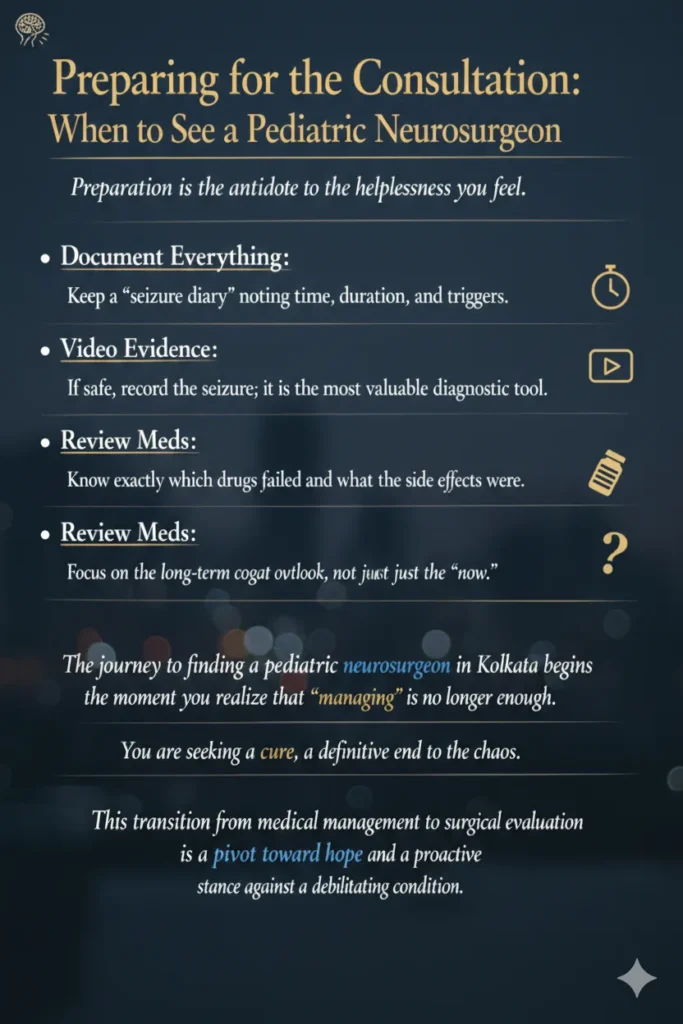
Beyond Normal Development: Recognising warning signs that are not “just a phase”
Repeated episodes, unusual behaviour, or developmental changes are red flags. Children do not “grow out” of seizures that originate from deeper neurological causes.
Symptoms that speak louder than words
These patterns align with childhood epilepsy symptoms, often subtle before they become obvious. Knowing when to escalate care depends on your ability to spot the subtle and the screaming signs.
- Sudden Staring: Often mistaken for daydreaming, this is an "absence seizure."
- Rhythmic Jerking: Classic tonic-clonic movements that signal a generalised event.
- Loss of Bladder Control: A common physical byproduct of a major seizure.
- Aura or Strange Smells: Sensory warnings that a focal seizure is imminent.
- Postictal Confusion: A period of deep exhaustion and disorientation after the event.
If your child displays these childhood epilepsy symptoms, the clock is ticking. You are no longer just a parent; you are a guardian of their neurological potential.
Seeking a pediatric neurosurgeon in Kolkata ensures that if the symptoms are tied to a structural defect, the window for intervention doesn't close.
Early vs concerning signs
Parents frequently miss them because they do not resemble textbook seizures.
| Early signs | Needs urgent evaluation |
| Single brief episode | Recurrent episodes |
| Fever-linked seizure | Afebrile seizures |
| Quick recovery | Confusion lasting hours |
| Normal development | Skill regression |
When patterns repeat, the brain is asking for deeper evaluation.
Risks of Uncontrolled Seizures in a Child
Uncontrolled seizures pose a direct threat to a child’s developing brain, potentially leading to "epileptic encephalopathy", where the seizure activity itself causes cognitive and behavioural decline.
Risks include permanent memory loss, developmental delays, physical injury from falls (SUDEP), and a significant decrease in the quality of life for the entire family.
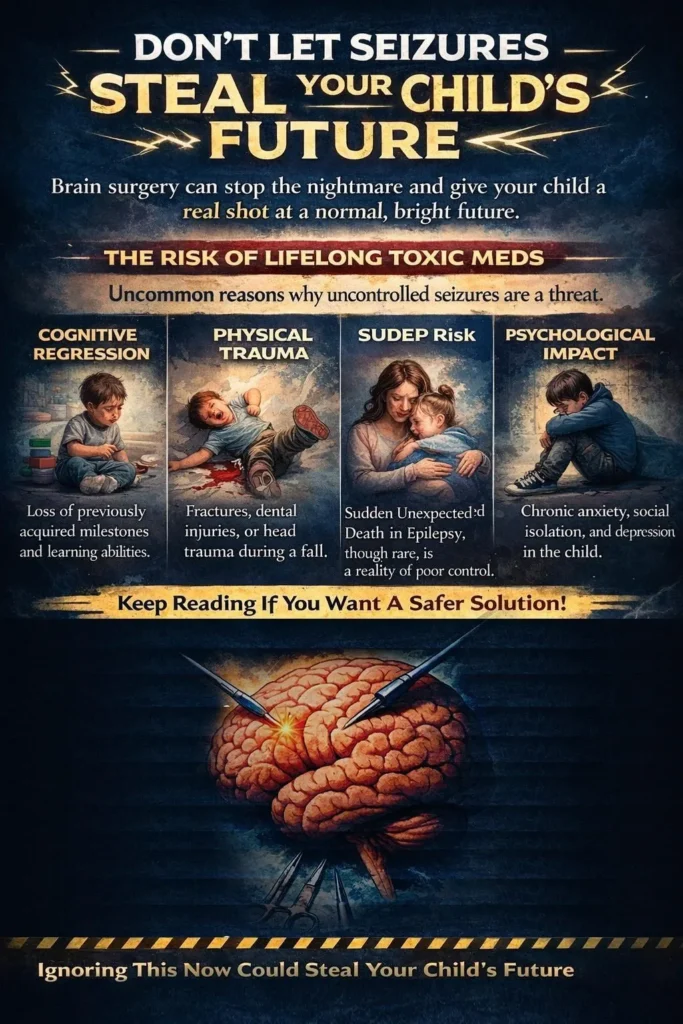
For parents, witnessing uncontrolled seizures in children is like living in a house where the fire alarm is always screaming, but no one is putting out the fire.
Every seizure is a micro-insult to the brain's delicate wiring. It is a brutal, exhausting cycle that demands an expert pediatric neurosurgeon in Kolkata to take decisive action.
The Path to Epilepsy Treatment in Children
Modern medicine offers a tiered approach to reclaiming control.
| Treatment Phase | Method | Objective |
| First Line | Pharmacotherapy (Anticonvulsants) | Suppress electrical activity |
| Second Line | Dietary Therapy (Ketogenic Diet) | Metabolic shift to reduce excitability |
| Third Line | Vagus Nerve Stimulation (VNS) | Neuromodulation via electrical pulses |
| Final Frontier | Resective Surgery | Permanent removal of the seizure focus |
Beyond Medication: Advanced Treatment Options for Childhood Epilepsy
Treatment shifts from suppression to correction. Medication controls symptoms. Surgery addresses sources.
- Detailed brain imaging
- Video EEG monitoring
- Functional brain mapping
- Multidisciplinary case review
Treatment pathways explained
Epilepsy treatment in children follows a stepwise model. Surgery is never rushed, but it should never be postponed out of fear.
When brain surgery becomes an option
| Scenario | Surgical consideration |
| Focal seizure origin | Lesion removal |
| Structural abnormality | Corrective surgery |
| Drug resistance | Surgical evaluation |
| Developmental regression | Early intervention |
Brain surgery for seizures is not about aggression. It is about protecting the child’s future.
Brain Surgery for Seizures: Is It a Safe and Viable Option
Brain surgery for seizures (pediatric epilepsy surgery) is a safe and highly viable treatment option for patients with drug-resistant epilepsy that can potentially cure specific conditions like temporal lobe epilepsy completely.
It's the go-to option when medications stop working—not experimental, but a medically established path to seizure freedom.
Visual Aid: When Brain Surgery Becomes the Safest Option to Stop Seizures
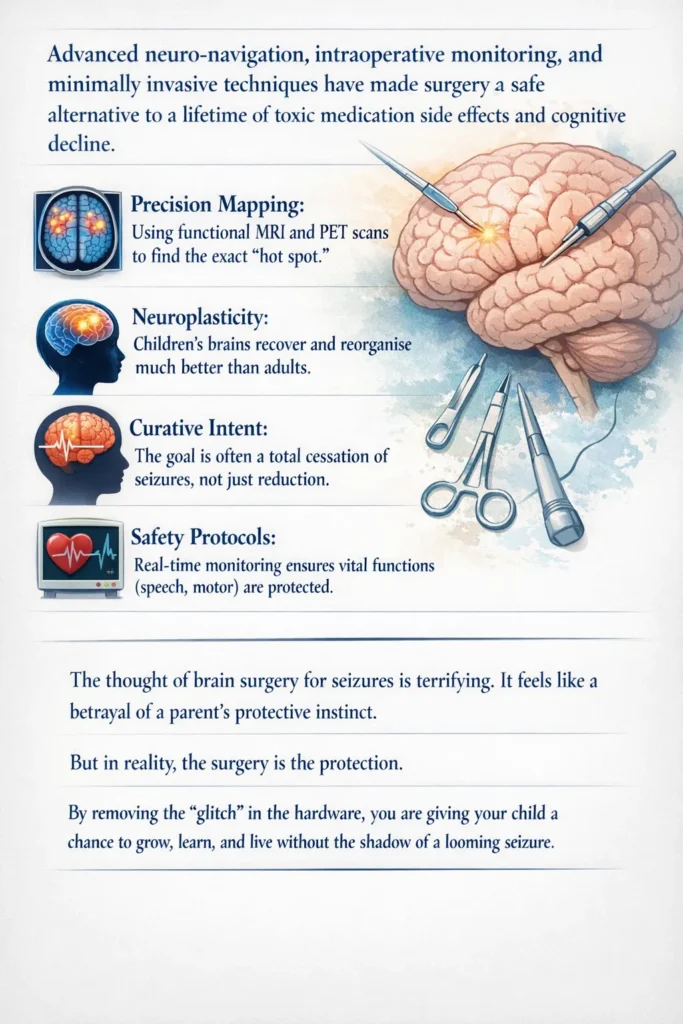
A skilled pediatric neurosurgeon in Kolkata uses technology to turn "terrifying" into "transformative."
To Summarise: Seizures aren’t episodes—they’re emergencies
Repeated seizures aren't episodes to monitor—they're emergencies stealing your child's potential.
When medications fail, a pediatric neurosurgeon can surgically remove the seizure source, offering a potential cure. Uncontrolled epilepsy causes permanent brain damage, developmental loss, and trauma.
When medications fail, every delay steals futures. The real risk isn't surgery—it's watching brilliance burn out, seizure by seizure.
Stop fearing the cure. Start fearing the wait.
Your child deserves a life unleashed, not a childhood stolen. Consult Dr Rohit Mishra, the leading pediatric neurosurgeon in Kolkata.
People Also Ask
Do neurosurgeons treat seizures?
Yes, neurosurgeons treat seizures when medications fail, structural brain causes exist, or surgical procedures can safely eliminate the seizure focus permanently.
How do you properly help a pediatric patient having a seizure?
Place the child safely on their side, protect the head, loosen clothing, avoid restraints, and never put objects inside the mouth.
Can childhood epilepsy cause brain damage?
Uncontrolled or frequent seizures can affect brain development, learning, and memory, especially in young children without timely treatment and monitoring.
When to see a neurologist for febrile seizures?
See a neurologist if febrile seizures last longer than five minutes, recur frequently, show focal features, or delay recovery significantly.