

A stroke strikes suddenly, and the brain gives no extra time. That’s why recognising the first warning signs — and understanding what kind of stroke it might be — can protect someone’s speech, memory, and even life.
Dr Rohit Mishra, a renowned cerebral stroke doctor in Kolkata, ensures patients get timely, neuro-focused care guided by advanced scans and experienced hands.
Understanding Stroke Types and Their Impact
Most strokes fall into two main groups — ischemic and hemorrhagic. Ischemic strokes happen when a clot blocks blood flow. Hemorrhagic strokes happen when a weak vessel bursts and bleeds inside the brain.
Both are emergencies. The treatment, however, is different. So the first goal is quick stroke diagnosis with CT or MRI.
Quick Look: Two Major Stroke Types
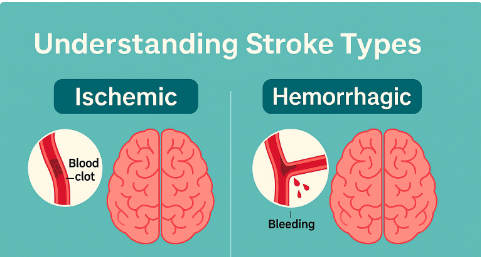
| Stroke type | What happens inside the brain |
| Ischemic | A blood vessel is blocked by a clot or plaque |
| Hemorrhagic | Vessel ruptures, causing a brain haemorrhage |
What Is an Ischemic Stroke?
Ischemic strokes are the most common type, accounting for about 80–87% of total cases.
A clot blocks an artery, depriving brain cells of oxygen. Typical ischemic stroke symptoms are face drooping, arm weakness, slurred speech, and sudden confusion. A mini version, called a transient ischemic attack, gives similar symptoms but clears in minutes. It’s still a warning shot.
Causes and Risk Factors (Ischemic)
- High blood pressure
- Diabetes
- High cholesterol
- Irregular heartbeat
Treatment Options (Ischemic)
If patients reach early, doctors may use clot-busting drugs or remove the clot mechanically. These are time-sensitive stroke treatment options, so consulting Dr Rohit Mishra, your trusted cerebral stroke doctor in Kolkata, matters fast.
What Is a Hemorrhagic Stroke?
Here, a vessel bursts and blood leaks into the brain tissue. This raises pressure and damages cells. Hemorrhagic stroke symptoms may include a sudden, severe headache, vomiting, seizures, or loss of consciousness. It often looks more dramatic than an ischemic stroke. CT scans show bleeding clearly.
Causes and Risk Factors (Hemorrhagic)
- Long-standing uncontrolled blood pressure
- Aneurysms or weak vessels
- Trauma
- Blood-thinning medicines
Treatment Options (Hemorrhagic)
Doctors control bleeding, lower pressure, and sometimes perform surgery to drain blood. This is where a neurosurgery-backed stroke unit, like the one led by Dr Rohit Mishra, a revered cerebral stroke doctor in Kolkata, becomes important.
Key Differences You Should Know
| Feature | Ischemic Stroke | Hemorrhagic Stroke |
| Main cause | Vessel blocked | Vessel ruptured |
| CT scan | May look normal early | Shows a bright blood area |
| Usual treatment | Clot removal/medicines | Bleed control/surgery |
| Urgency | Very high | Very high |
CT is performed first to rule out bleeding, as the two treatments are mutually exclusive. You can’t give clot-busters in a bleed. That’s why stroke diagnosis must be quick and exact.
Importance of Timely Diagnosis and Intervention
Every passing minute kills brain cells. Specialists call it “time is brain.” Early arrival improves stroke recovery and reduces the risk of disability. Early rehabilitation also accelerates stroke rehabilitation and helps patients regain the ability to walk, talk, and return to work.
An experienced cerebral stroke doctor in Kolkata can coordinate neurology, neurosurgery, ICU, and physiotherapy in one plan.
Preventive Measures and Lifestyle Modifications
- Keep BP and sugar under control
- Quit smoking and limit alcohol
- Walk or exercise daily
- Follow the medicines for heart rhythm problems
These steps support long-term stroke prevention and protect the brain.
When a “Mini Stroke” Happens
A TIA or transient ischemic attack looks like a stroke but fades fast. Don’t ignore it. It often predicts a bigger stroke in days. Get an evaluation, heart check, and neck vessel scan without delay.
Life After Stroke
Recovery doesn’t end at discharge. Many people improve for months with speech therapy, physiotherapy, and counselling. That’s your stroke rehabilitation roadmap.
Stay positive — the brain can relearn. Good follow-up reduces later brain haemorrhage or repeat stroke.
Act Fast, Choose Expert Care
Only a scan can tell if it’s ischemic or hemorrhagic. The earlier the scan, the safer the treatment. For advanced, judgement-based stroke care, reach out to Dr Rohit Mishra, your trusted cerebral stroke doctor in Kolkata.