
Spine Tumour Treatment In Kolkata
- 1,850+ spine surgeries across complex conditions
- Head of Neurosurgery, Charnock Hospital
- Fellowship-trained in minimally invasive neuroendoscopy
Home / Treatments / Spine Tumor

Need a Neurosurgical Opinion?
Discuss your symptoms, scans or treatment options with Dr Rohit Mishra.
Get In Touch +91 91473 80550Other Treatments
For Your Clarity
Facts At A Glance
Are all spinal tumours cancerous?
No, spinal tumours can be benign or malignant. Diagnosis determines their nature and treatment requirements.
Does every spinal tumour require surgery?
No, treatment depends on tumour type, location, symptoms, and neurological involvement.
Can spinal tumours affect walking?
Yes, spinal tumours may compress nerves or the spinal cord, potentially affecting strength, balance, and mobility.
Is spinal tumour surgery always open surgery?
No, selected cases may involve minimally invasive techniques. Surgical approaches depend on tumour location and complexity.
Understanding Abnormal Growths
What Is A Spine Tumour?
An abnormal mass of tissue—either noncancerous (benign) or cancerous (malignant)—that forms within or around the spinal cord or the bones of the vertebral column. Surgery may be recommended to remove the tumour, relieve spinal cord compression, and preserve neurological function.
Lesser-Known Facts About Spine Tumours
- Most spinal tumours originate elsewhere.
- Tumour-related pain may worsen at night.
- Benign tumours can cause neurological damage.
- Spinal tumours remain hidden within bones.
Why Expertise Matters
- Spinal tumours require precise surgical planning.
- Tumour location influences surgical complexity.
- Spinal cord protection remains a priority.
- Surgery may help preserve neurological function.
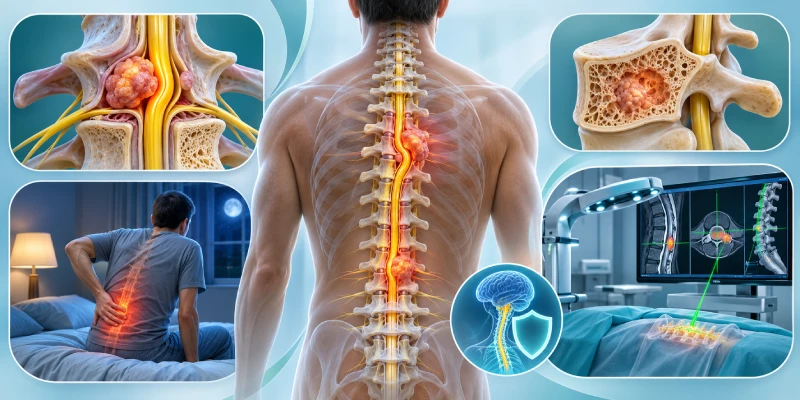
What To Watch Out For
Signs You May Need Spine Tumour Treatment
Symptoms depend on the tumour's location, size, growth characteristics, and degree of spinal cord or nerve compression.
Common Symptoms
- Back pain that often worsens at night
- Numbness or tingling in the arms or legs
- Muscle weakness
- Difficulty walking or maintaining balance
- Loss of bowel or bladder control
- Unexplained weight loss
- Spinal deformities in advanced cases
Myths Vs Facts
| Myth | Fact |
|---|---|
| “Spinal tumours always grow rapidly” | Growth rates vary between types. |
| “Back pain always indicates spinal tumours” | Most back pain has other underlying causes. |
| “Spinal tumours always require surgery” | Treatment depends on tumour characteristics and symptoms. |
| “Spinal tumours always cause paralysis” | Neurological outcomes depend on tumour location and involvement. |
Red Flags: Don't Wait
- Progressive weakness or numbness in limbs.
- Sudden difficulty walking, standing, or balancing.
- New bladder or bowel control problems.
- Severe back pain disrupting sleep or rest.
- Tingling or electric shock sensations.
Exploring Underlying Causes
Causes and Risk Factors
Spinal tumours may develop within or around spinal structures. Their underlying causes and risk factors depend on tumour type, location, and individual medical history.
Main Causes
- Metastasis from other body cancers.
- Genetic mutations causing abnormal cell growth.
- Inherited genetic disorders (NF2, VHL).
- Abnormal growth of spinal tissues.
- Tumours involving surrounding nerve tissues.
Factors Influencing Surgical Requirements
- Tumour size, location and characteristics.
- Spinal cord or nerve compression.
- Neurological symptoms and their severity.
- Spinal instability from vertebral erosion.
- Overall health, tumour type, and treatment response.
Why Timely Treatment Matters
Complications Of Untreated Spine Tumours
Certain spinal tumours may cause progressive complications when appropriate medical evaluation and treatment are delayed.
Permanent Nerve Damage and Paralysis
- Irreversible sensory loss
- Chronic muscle weakness
- Partial or complete paralysis
Bowel and Bladder Dysfunction
- Urinary and faecal incontinence
- Chronic urinary retention
- Increased kidney infection risk
Spinal Instability and Deformities
- Vertebral fractures or collapse
- Severe spinal misalignment
- Chronic, unmanageable pain
Respiratory Failure
- Cervical spinal nerve compression
- Life-threatening breathing difficulties
- Mechanical ventilation may become necessary
Secondary Life-Threatening Complications
- Deep vein thrombosis
- Pulmonary embolism
- Pressure ulcers and pneumonia
Informed Decisions, Safer Care
Is Spine Tumour Surgery Safe?
During consultation, Dr Rohit Mishra will explain the potential risks, surgical approach and expected outcomes beforehand.
| Possible Risk | How It Is Reduced |
|---|---|
| Nerve Damage | Real-time neuromonitoring tracks nerve health. |
| Infection | Sterile techniques and preventative antibiotics are used. |
| Spinal Instability | Advanced rods and screws secure the spine. |
| Blood Loss | Minimally invasive techniques limit tissue disruption. |
Understanding the Problem
Diagnosis Of Spine Tumour
Diagnosis involves neurological evaluation, imaging and, when necessary, tissue analysis to determine the tumour's characteristics, location and treatment requirements.
- Neurological and physical examination
- MRI scans with contrast when necessary
- CT scans or CT myelography
- PET scans or X-rays when indicated
- Blood tests and laboratory evaluation
- Tissue biopsy when necessary
- Cerebrospinal fluid examination in selected cases.
Precision Surgical Care
Effective Spine Tumour Surgeries
Dr Rohit Mishra, as a spinal tumour surgeon in Kolkata, specialises in the following approaches!
Microsurgical Tumour Resection
Microsurgical techniques help remove spinal tumours partially or completely while protecting surrounding nerves and delicate spinal cord structures.
En Bloc Resection
When feasible, the entire tumour is removed in one piece to minimise tumour disruption and support appropriate surgical management.
Debulking / Partial Tumour Removal
Surgeons remove as much tumour tissue as safely possible to reduce spinal cord compression and relieve pressure on surrounding structures.
Minimally Invasive Spinal Tumour Surgery
Smaller incisions and specialised instruments may help access selected spinal tumours while minimising muscle damage and supporting recovery.
Laminectomy
The lamina is removed to create access to the spinal canal, relieve pressure, and facilitate tumour removal when necessary.
Separation Surgery
Tumour tissue adjacent to the spinal cord is removed to create separation before targeted radiation therapy in selected cases.
Spinal Cord Decompression
Surgical decompression relieves pressure on the spinal cord or nerve roots caused by tumour growth or associated spinal changes.
Spinal Stabilisation and Fusion
Screws, rods, and bone grafts help stabilise affected vertebrae when tumour involvement or surgical removal compromises spinal stability.
Vertebroplasty
Medical-grade bone cement is injected into weakened or fractured vertebrae to provide structural support and potentially relieve pain.
Kyphoplasty
A balloon creates space within a fractured vertebra before cement injection, potentially restoring vertebral height and improving stability.
Posterolateral / Side-Access Resection
Surgeons approach selected spinal tumours from the side, potentially reducing disruption to surrounding muscles and supporting recovery.
Preoperative Tumour Embolisation
An interventional radiologist blocks selected tumour blood vessels before surgery to reduce blood loss during surgical removal.
Preparing for What’s Next
Your Spine Tumour Surgery Journey—Step-by-Step
-
Diagnostic and Evaluation Phase
Persistent back pain, radiating nerve pain, numbness, weakness, or bowel/bladder changes prompt MRI, CT scans, targeted biopsy, and specialist consultations to assess the tumour and plan treatment.
-
Pre-Operative Preparation
Medical history review, blood tests, cardiac evaluations, medication adjustments, anaesthesia planning, and neuromonitoring arrangements help assess surgical readiness and safety.
-
Surgery Day
General anaesthesia, surgical positioning, spinal access, laminectomy or microsurgical tumour removal, and spinal stabilisation when necessary constitute the main operative steps.
-
Immediate Post-Operative Recovery
Hospital monitoring, neurological assessments, pain management, supervised walking, wound care, and discharge instructions help support early recovery following surgery.
-
Rehabilitation and Long-Term Recovery
Gradual walking, physical therapy, strengthening exercises, activity progression, follow-up MRIs, and additional radiation therapy when indicated support recovery and functional improvement.

Progress Through Recovery
Recovery Timeline After Spine Tumour Surgery
-
Hospital Days 1–7
Medical CareVital monitoring; early walking.
Symptoms & RestrictionsIncision pain; no bending or lifting.
-
Weeks 1–2
Medical CareWound checks; medication taper.
Symptoms & RestrictionsFatigue; maximum weight limit 4 kg.
-
Weeks 3–4
Medical CareFirst follow-up; initial physical therapy.
Symptoms & RestrictionsNerve pain eases; avoid strenuous twists.
-
Months 2–3
Medical CareRehab progress; return-to-work review.
Symptoms & RestrictionsMuscle healing; avoid heavy contact sports.
Answers to Common Queries
Frequently Asked Questions
Can spinal tumours remain undetected initially?
Yes. Small or slow-growing growths may cause no noticeable symptoms and may appear incidentally on unrelated imaging investigations.
Do spinal tumours always originate in the spine?
No. Some originate elsewhere in the body and spread through metastatic processes, affecting vertebrae or other spinal structures.
Are spinal tumours always detected through X-rays?
No. X-rays mostly show bone changes. MRIs are required to see soft-tissue tumours, nerves, and the spinal cord.
Do spinal tumours produce identical symptoms?
No. Symptoms vary widely—from neck and arm numbness to lower back pain—depending on the tumour's location.
Can spinal tumours affect surrounding tissues?
Yes. Enlarging growths may compress nearby nerves, blood vessels, ligaments, or spinal cord structures, potentially affecting neurological function.