
Spondylolisthesis, spinal stenosis, and degenerative disc disease are closely related spinal conditions that often develop together as the spine ages or undergoes wear and tear. Degenerating discs can reduce spinal stability, leading to vertebral slippage and narrowing of the spinal canal, which may compress nearby nerves.
As these conditions frequently overlap, diagnosis and treatment require a comprehensive assessment rather than addressing each problem separately.
An experienced neurosurgeon evaluates the entire spine to identify the underlying cause and create an integrated treatment plan.
What Is the Connection Between These Three Spinal Conditions?
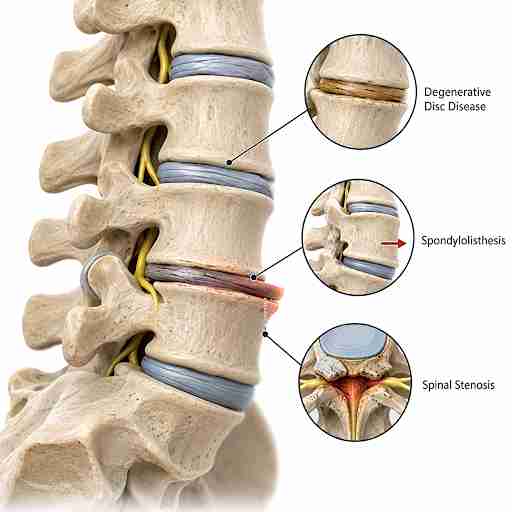
Spondylolisthesis, spinal stenosis and degenerative disc disease are closely related because age-related changes in the spine often occur together.
As discs lose height and hydration, spinal stability decreases, which may contribute to vertebral slippage and narrowing of the spinal canal, increasing the risk of nerve compression and related symptoms.
Quick View: How These Three Spinal Conditions Are Connected
| Condition | What Happens | Clinical Impact |
| Degenerative Disc Disease | Spinal discs gradually lose water content, height, and cushioning ability. | Reduces spinal stability and increases mechanical stress on nearby joints and ligaments. |
| Spondylolisthesis | A vertebra slips forward over the one below due to loss of spinal stability. | May alter spinal alignment and contribute to narrowing around the spinal nerves. |
| Spinal Stenosis | The spinal canal or nerve passages become narrowed due to degenerative changes. | Compresses the spinal nerves, causing pain, numbness, weakness, or difficulty walking. |
What Is Spondylolisthesis?
Spondylolisthesis is a spinal condition in which one vertebra slips forward over the vertebra beneath it. The degree of slippage can range from mild to severe and may lead to back pain, nerve compression, or reduced mobility.
Causes and Grades of Spondylolisthesis
- Age-related degeneration of the spinal discs and facet joints (most common in older adults)
- Stress fractures of the pars interarticularis (isthmic spondylolisthesis)
- Congenital abnormalities present from birth
- Traumatic spinal injuries
- Less commonly, spinal tumours or infections
Doctors classify the condition according to the extent of vertebral slippage:
| Grade | Degree of Slippage |
| Grade I | Up to 25% |
| Grade II | 26-50% |
| Grade III | 51-75% |
| Grade IV | 76-100% |
| Grade V (Spondyloptosis) | Complete displacement of the vertebra |
The severity grade is considered alongside symptoms, neurological findings, and evidence of spinal instability when planning treatment.
Common Symptoms
- Persistent lower back pain
- Pain radiating into one or both legs (sciatica)
- Numbness or tingling in the legs or feet
- Muscle weakness
- Tight hamstrings
- Difficulty standing or walking for long periods
- Pain that worsens with activity or prolonged standing
- Relief when sitting or bending slightly forward
Takeaway: Some people have mild spondylolisthesis without noticeable symptoms.
However, persistent back pain, progressive leg weakness, or changes in walking should always be evaluated by a neurosurgeon to prevent further spinal or nerve damage.
What Is Spinal Stenosis?
Spinal stenosis is a condition in which the spaces within the spine become narrowed, placing pressure on the spinal cord or spinal nerves. It most commonly affects the neck and lower back and often develops gradually due to age-related changes in the spine.
Causes of Spinal Canal Narrowing
- Degenerative disc disease causing loss of disc height
- Enlargement of the facet joints due to osteoarthritis
- Thickening of the ligamentum flavum, which can encroach on the spinal canal
- Bone spur (osteophyte) formation
- Spondylolisthesis, where vertebral slippage further narrows the canal
- Congenital narrowing of the spinal canal (less common)
- Spinal injuries or tumours (rare)
These structural changes can lead to nerve compression, resulting in pain and neurological symptoms.
Common Symptoms
Symptoms depend on the location and severity of the narrowing. Common signs include:
- Neck or lower back pain
- Pain radiating into the arms or legs
- Numbness or tingling in the limbs
- Muscle weakness
- Difficulty walking or maintaining balance
- Leg pain or heaviness that worsens with walking and improves after sitting or bending forward (neurogenic claudication)
- Reduced walking endurance
Remember: Mild spinal stenosis may not cause symptoms initially.
However, progressive weakness, balance problems, or bowel and bladder dysfunction require prompt medical evaluation, as they may indicate significant nerve involvement.
What Is Degenerative Disc Disease?
Degenerative disc disease is an age-related condition in which the intervertebral discs gradually lose water content, height, and flexibility. Although it is not a disease in the traditional sense, these changes can reduce the spine's ability to absorb shock and contribute to pain, instability, or nerve irritation.
Causes of Disc Degeneration
Intervertebral discs naturally undergo wear and tear with age. However, several factors can accelerate degenerative disc disease, including:
- Natural ageing
- Repetitive bending, lifting, or twisting movements
- Previous spinal injuries or trauma
- Smoking, which reduces blood supply to the discs
- Excess body weight, increasing stress on the spine
- Genetic predisposition
- Poor posture and prolonged mechanical strain
As the discs lose height and cushioning ability, greater stress is placed on the surrounding joints, ligaments, and vertebrae, increasing the risk of other degenerative spinal conditions.
Common Symptoms
Disc degeneration can cause symptoms that vary depending on the affected spinal level and whether nearby nerves are irritated.
- Persistent neck or lower back pain
- Pain that worsens while sitting, bending forward, or twisting
- Pain that improves with walking, changing position, or lying down
- Pain radiating into the buttocks and legs (sciatica) or into the shoulders and arms
- Numbness or tingling in the arms, hands, legs, or feet
- Muscle weakness or difficulty gripping objects
- A feeling that the arms or legs may become weak or give way
Keep in mind: Many people have age-related disc changes without symptoms.
These indications should be evaluated to identify the underlying cause and determine the most appropriate treatment.
How Do Spondylolisthesis, Spinal Stenosis, and DDD Overlap?
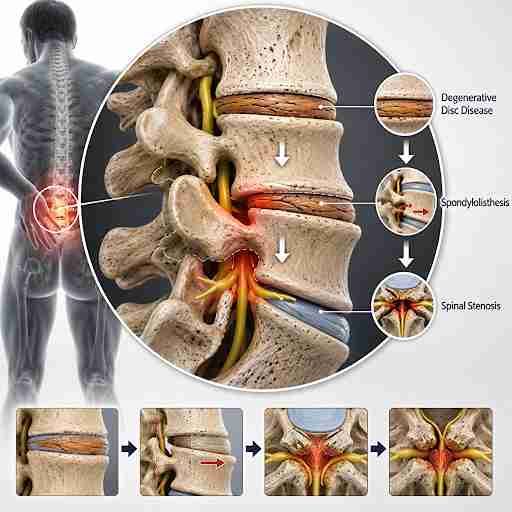
Spondylolisthesis, spinal stenosis, and degenerative disc disease (DDD) often develop together as the spine ages. Disc wear reduces spinal stability, vertebral slippage narrows the spinal canal, and nerve compression causes symptoms such as back pain, leg pain, numbness, and weakness.
How Disc Wear Triggers Vertebral Slippage
Disc wear reduces spinal stability, increasing stress on joints and ligaments until one vertebra gradually slips over another.
- Reduced disc height
- Segmental instability
- Increased facet joint loading
- Ligament laxity develops
- Progressive vertebral slippage
How Slippage Narrows the Spinal Canal
Vertebral slippage and surrounding degenerative changes reduce the space available for the spinal cord and nerve roots.
- Narrowed spinal canal
- Compressed nerve roots
- Thickened spinal ligaments
- Enlarged facet joints
- Pain, numbness, weakness
Why Multiple Spinal Levels Are Often Affected
Age-related spinal wear commonly affects several segments, making multilevel spine degeneration treatment important when symptoms arise from more than one level.
- Multiple discs deteriorate
- Adjacent segments overloaded
- Widespread spinal wear
- Symptoms differ by level
- Individualised treatment planning
Wondering, “Is Your Slip Disc Getting Worse?” Get it checked today.
How Is the Overlap Diagnosed?
The overlap between spondylolisthesis, spinal stenosis, and degenerative disc disease is diagnosed through a combination of targeted clinical examinations and imaging studies.
Together, these assessments identify the source of pain, detect nerve involvement, measure spinal instability, and determine the severity of structural changes, helping the neurosurgeon choose the most appropriate treatment plan.
Physical and Neurological Examination
- Lumbar range-of-motion assessment: Checks spinal mobility and stiffness.
- Straight Leg Raise (SLR) test: Detects lumbar nerve root irritation.
- Femoral Stretch Test: Identifies upper lumbar nerve involvement.
- Myotome testing: Assesses muscle weakness from nerve compression.
- Dermatome sensory testing: Evaluates numbness and altered sensation.
- Patellar and Achilles reflex tests: Checks neurological function.
- Gait and heel-toe walking: Assesses balance, coordination, and walking ability.
Imaging: X-ray, MRI, and CT Scans
- X-rays assess vertebral alignment and instability.
- MRI detects disc degeneration, spinal stenosis, and nerve compression.
- CT scans provide detailed images of the vertebrae when required.
Grading Severity for Treatment Planning
- Spondylolisthesis
Graded using the Meyerding classification, from Grade I (0-25%) to Grade V (complete vertebral slippage).
- Degenerative Disc Disease
MRI commonly uses the Pfirrmann grading system (Grades I-V) to assess disc hydration, height, and structural changes.
- Spinal Stenosis
MRI assesses the severity of central canal and foraminal narrowing as mild, moderate, or severe, helping determine the extent of nerve compression.
Consult a spine specialist if you have persistent pain, progressive weakness, or difficulty walking.
How Does a Neurosurgeon Treat These Conditions Together?
For spinal stenosis, spondylolisthesis and degenerative disc disease, a neurosurgeon recommends treatment based on symptom severity, spinal stability, nerve compression, imaging findings, and response to conservative care.
Non-Surgical Treatment: Physiotherapy, Medication, Injections
- Physiotherapy to improve flexibility and core strength.
- Medications to reduce pain and inflammation.
- Epidural steroid injections for persistent nerve pain.
When Do You Need Surgery for Spinal Stenosis?
- Persistent pain despite conservative treatment.
- Progressive leg weakness or numbness.
- Difficulty walking or worsening neurological symptoms.
Minimally Invasive Surgery Options
- Micro-decompression (Laminotomy/Laminectomy)
- Lumbar Decompression (MILD/PILD)
- Foraminotomy
- Spinal fusion
Spinal Fusion for Combined Instability
Essentially a form of spine fixation surgery, it helps -
- Stabilises unstable spinal segments.
- Commonly recommended for vertebral slippage.
- Helps restore spinal alignment and function.
Lumbar Spondylolisthesis Treatment Options
Non-Surgical Treatment Options
- Physical therapy
- Activity modification
- Medications
- Lumbar bracing
- Epidural steroid injections
Surgical Treatment Options
- Decompression (Laminectomy)
- Spinal fusion
What Does Recovery Look Like After Treatment?
| Treatment | Typical Recovery Timeline* |
| Physiotherapy and medication | Symptom improvement may begin within 4-8 weeks. |
| Epidural steroid injections | Pain relief may occur within a few days to 2 weeks. |
| Minimally invasive spine surgery | Most patients resume light activities within 2-6 weeks. |
| Spinal fusion surgery | Bone fusion develops over 6-12 months, with recovery progressing gradually. |
Why Choose a Neurosurgeon for This Kind of Overlapping Spine Condition?
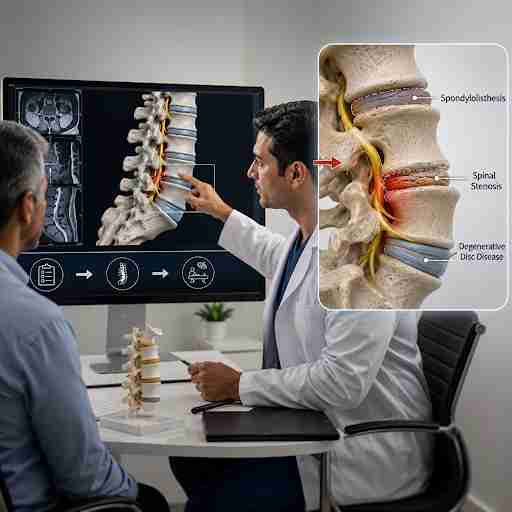
When multiple spinal conditions coexist, accurate diagnosis is essential because treatment depends on identifying the primary pain source.
As a spine specialist for degenerative disc disease and neurosurgeon in Kolkata for spine conditions, Dr Rohit Mishra has performed 1,500+ spinal surgeries and serves as Head of Neurosurgery at Charnock Hospital.
Call today to book a consultation.
People Also Ask
Can Spondylolisthesis, Spinal Stenosis, and Degenerative Disc Disease Occur Together?
Yes. Degenerative disc disease can contribute to spondylolisthesis and spinal stenosis, commonly affecting older adults simultaneously.
What Treatment Does a Neurosurgeon Recommend for This Combination?
Treatment combines physiotherapy, medications, injections, or surgery, depending on nerve compression, instability, symptom severity, and neurological deficits.
Is Surgery Always Needed When These Conditions Overlap?
No. Surgery is reserved for persistent symptoms, neurological deficits, spinal instability, or failed conservative treatment despite adequate non-surgical care.
What Is the Difference Between Spine Surgery and Minimally Invasive Spine Surgery?
Minimally invasive spine surgery uses smaller incisions, causing less tissue damage, reduced pain, and faster recovery than traditional surgery.
How Long Is Recovery After Spine Surgery for These Conditions?
Recovery varies. Light activities often resume within weeks, while complete healing after spinal fusion may require several months.
Can Physiotherapy Alone Manage Overlapping Spine Conditions?
Yes, for mild to moderate cases without progressive neurological deficits or significant spinal instability requiring surgical intervention.
When Should You Consult a Neurosurgeon Instead of an Orthopaedic Doctor?
Consult a neurosurgeon when persistent nerve compression, progressive weakness, numbness, or bowel and bladder symptoms develop.
Is Spinal Fusion Necessary for Spondylolisthesis With Stenosis?
Not always. Spinal fusion is considered when instability accompanies stenosis or decompression alone cannot maintain spinal stability.