
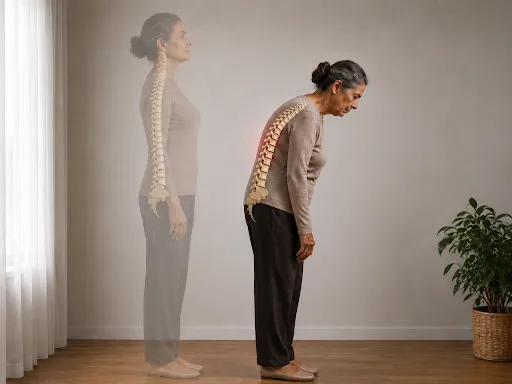
Losing some height with age can be normal, but noticeable or progressive height loss with a changing spinal shape deserves attention. Vertebral compression fractures, osteoporosis-related bone weakening, kyphosis, scoliosis and age-related spinal changes can all contribute.
The pattern, speed of change, pain and other symptoms help determine whether the change is simply age-related or needs medical evaluation.
Why Height Loss Happens as We Age — And When It’s Not Normal
A small reduction in height can occur with ageing, but rapid or substantial loss may indicate changes in the vertebrae or spinal alignment that warrant assessment.
Losing about half an inch of height every ten years after age 40 can be a normal part of ageing.
Quick View:
| Normal with Ageing | Not Normal |
| About ½ inch every 10 years after 40 | Losing 2–3 inches or more |
| Gradual height reduction | Rapid or significant shrinking |
| Often related to spinal disc changes | May indicate osteoporosis |
| Weaker muscles and posture changes | Possible compression fractures in the spine |
| Flattening of foot arches | Increased risk of hip, spine or wrist fractures |
Vertebral Compression Fractures — A Leading Cause
VCFs when a vertebra weakens and partially collapses, potentially causing back pain, height loss and increased spinal curvature. Osteoporosis is a major risk factor [Source].
However, trauma and other conditions affecting bone strength can also cause fractures.
Osteoporosis and Spine Curvature
Osteoporosis makes vertebrae more vulnerable to collapse, sometimes during routine movements. Repeated fractures can progressively increase thoracic kyphosis and alter spinal alignment.
Compression Fracture Back Pain — What It Feels Like
Pain may develop suddenly after bending, lifting or movement and can worsen with position changes.
- Sudden or new back pain
- Local tenderness
- Pain with movement
- Reduced mobility
Some fractures cause little or no pain and may first become apparent through height loss or increasing curvature.
Gradual vs. Sudden Vertebral Collapse
| Pattern | Possible concern |
| Sudden pain and collapse | Acute fracture |
| Gradual height reduction | Progressive collapse |
| Repeated collapse | Multiple fractures |
| Increasing forward curve | Progressive deformity |
Multiple compression fractures can progressively increase thoracic curvature and reduce height.
Spinal Kyphosis — Why the Upper Back Curves Forward
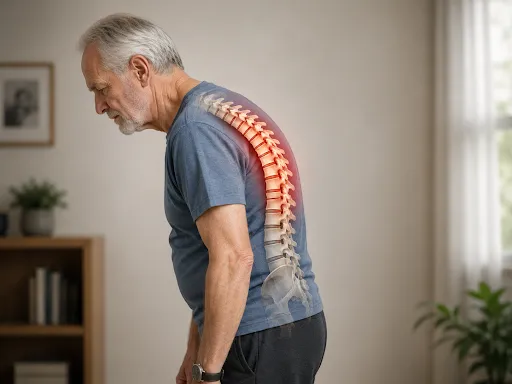
Kyphosis is an excessive forward curve of the upper spine that can develop from vertebral changes, ageing, posture or structural abnormalities. [Source]. A mild curve may cause few problems, while a progressive or rigid curve can affect posture, movement and, in severe cases, nerve or breathing function.
Hunched Back Causes in Adults
Other possible contributors include:
- Age-related spinal changes
- Vertebral compression fractures
- Long-standing poor posture
- Abnormal vertebral shape
- Previous spinal injury
Assess a visible hump by how it developed, whether it is flexible, and whether pain or neurological symptoms are present.
Postural vs. Structural Kyphosis
| Feature | Postural kyphosis | Structural kyphosis |
| Spine flexibility | Usually flexible | Usually fixed or less flexible |
| Position effect | Improves when upright | Persists despite correction |
| Main concern | Posture and muscle imbalance | Bone or structural change |
| Assessment | Clinical examination | Examination plus imaging |
Structural changes can result from altered vertebral shape, fractures or other spinal conditions.
Adult-Onset Scoliosis — When the Curve Goes Sideways
It is a sideways curvature of the spine that can develop in adulthood as discs, facet joints and other supporting structures deteriorate unevenly.
Unlike a simple posture change, this spinal deformity may cause back pain, leg symptoms, walking difficulties and progressive imbalance.
Symptoms that should not be ignored include:
- Persistent or worsening back pain
- Pain travelling into the leg
- Numbness or tingling
- Increasing difficulty standing upright
- Reduced walking tolerance
- A noticeable shift in body alignment
Degenerative Spine Changes That Contribute to Curvature
Age-related degeneration can gradually change spinal alignment when discs, facet joints and supporting structures deteriorate unevenly. This may create asymmetrical loading, causing the spine to become progressively imbalanced rather than simply “wearing out” uniformly.
The process may involve:
- Uneven disc height loss
- Facet joint degeneration
- Vertebral displacement
Muscle fatigue from altered alignment - Narrowing around spinal nerves
These changes can contribute to pain, altered posture and difficulty remaining upright for long periods. In adult degenerative scoliosis, pain may improve when sitting or supporting the trunk because this reduces the mechanical demand on the affected spine.
Warning Signs — When to See a Spine Surgeon for a Curved Back
Watch for:
- Rapid height loss over a relatively short period
- A visible hump that is becoming more pronounced
- Numbness, tingling or weakness in an arm or leg
- Persistent pain that does not improve with rest
- Increasing difficulty standing upright
- New walking or balance problems
- Pain after a minor fall or simple movement
A combination of symptoms is often more useful than relying on one warning sign alone. Older age, trauma and corticosteroid use, for example, can increase suspicion of a vertebral fracture.
How Spinal Deformity Is Diagnosed and Treated
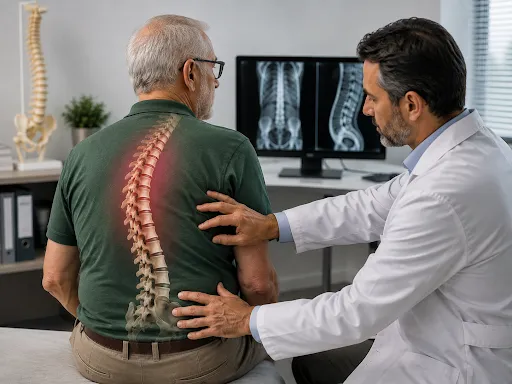
Diagnosis involves a physical exam and imaging tests, while treatment may include non-surgical care or surgery, depending on the deformity's severity.
Non-Surgical Management
- Observation: Doctors may monitor mild curves regularly.
- Physical therapy: Exercises improve strength, posture and mobility.
- Bracing: Helps prevent curve progression in growing children.
- Medications: Pain relievers can help manage discomfort.
When Surgery Becomes Necessary
- Vertebroplasty: Stabilises painful vertebral compression fractures.
- Spinal fusion: Joins vertebrae to stabilise and straighten the spine.
- Deformity correction: Realigns the spine and corrects significant curvature.
The goal is to address the cause, symptoms, function, neurological safety and spinal balance.
What to Expect During Your Consultation
Your consultation focuses on identifying why the spine is changing and whether the curve, nerves or spinal stability are affected. Assessment may include your medical history, posture, movement, and a neurological examination, supported by standing X-rays, CT, or MRI when required.
You may discuss:
- When height loss or curvature began
- Changes in pain or mobility
- Numbness, weakness or walking difficulty
- Previous falls, fractures or treatments
- Existing spinal or bone conditions
Imaging helps assess alignment, fractures, discs and nerve involvement. Treatment recommendations are based on symptoms, findings, overall health and potential benefits and risks—not appearance alone.
Final Takeaway: Don’t Dismiss a Changing Spine as Just Ageing
A changing spine is not always a normal part of getting older.
- Height loss may result from vertebral fractures, osteoporosis or degeneration.
- Kyphosis and scoliosis can progressively change spinal alignment.
- Persistent pain, numbness, weakness, or difficulty walking needs attention.
- Early evaluation helps identify the cause and determine the most suitable treatment.
If your height or spinal shape is changing, book a consultation today for a proper spine assessment.
People Also Ask
Is losing height with age always caused by osteoporosis, or can other conditions cause it too?
No. Osteoporosis and vertebral fractures are important causes, but disc degeneration, kyphosis, scoliosis, posture and other spinal changes can also reduce apparent or measured height.
Can a curved spine be corrected without surgery?
Sometimes. Treatment may include physical therapy, activity modification, pain management and management of underlying bone disease, depending on the cause and severity.
How much height loss is considered a red flag that needs medical evaluation?
There is no universal cut-off. Progressive loss, particularly when accompanied by back pain or increasing curvature, warrants assessment; some literature specifically flags losses above 6 cm when evaluating possible vertebral compression fractures.
What’s the difference between kyphosis and scoliosis in adults?
Kyphosis is mainly an excessive forward curve, while scoliosis involves sideways curvature and rotation of the spine. Adults can have either condition or a combination of spinal alignment changes.
Is spinal curvature in older adults always related to bone density loss?
No. Low bone density can cause vertebral fractures and contribute to curvature, but disc degeneration, joint changes, muscle weakness and other structural problems can also alter spinal alignment.