
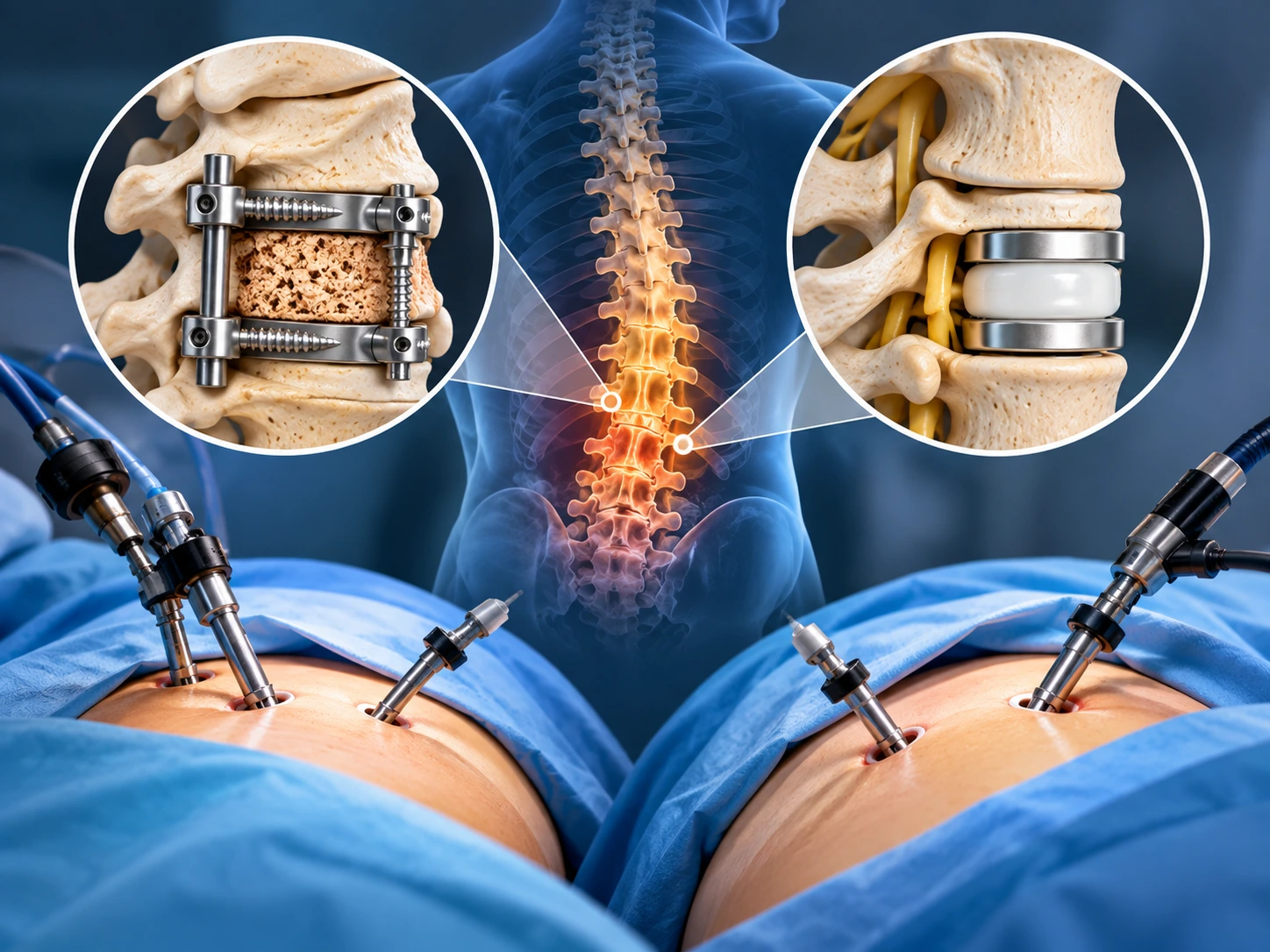
Yes. Selected spinal fusion and disc replacement procedures can be performed through smaller incisions and specialised access routes. The approach depends on the spinal level, diagnosis, anatomy, spinal stability, and the required procedure.
MISS is not suitable for every patient, so careful imaging and clinical assessment are essential.
What “Minimally Invasive” Actually Means in Spine Surgery
It means using small incisions, specialised microscopic cameras and tubular instruments; this approach gently moves muscles aside rather than cutting or stripping them from the bone. [Source].
Core Principles & Common Features
- Tissue preservation: Uses smaller incisions and less muscle dissection to reduce tissue disruption, blood loss and recovery time.
- Targeted access: Tubular or endoscopic systems provide focused access to the affected spinal level, often with image guidance.
- Still major surgery: A small incision does not make spinal surgery minor. Procedures such as fusion remain major internal reconstructions, even when performed through tubular access.
- Recovery: Selected patients may have shorter hospital stays.
Bottom line: Minimally invasive spine surgery (MISS) does not mean that the operation is minor. The complexity depends on the condition being treated and the structures involved.
Traditional Open Spine Surgery vs the Minimally Invasive Approach
Conventional surgery generally requires a wider exposure, while a less invasive approach uses a more targeted pathway.
| Feature | Conventional approach | Minimally invasive approach |
| Incision | Usually larger | Usually smaller |
| Muscle exposure | Greater | More limited |
| Surgical access | Wider exposure | Targeted access |
| Tissue disruption | Generally greater | Generally reduced |
| Recovery | Depends on procedure and patient | May be shorter in selected cases |
Neither approach is automatically appropriate for every patient. The surgical plan should be based on the condition, spinal anatomy, required correction and surgeon's assessment.
Spinal Fusion — Can It Be Done Minimally Invasively?
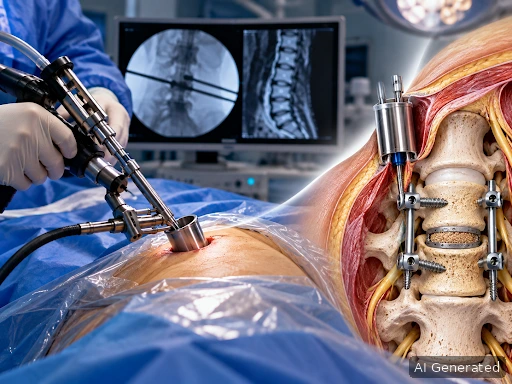
Yes. Through smaller access routes. The purpose of this spine surgery remains the same: stabilise the affected spinal segment by joining adjacent vertebrae so that solid bone healing can occur.
How Endoscopic and Percutaneous Fusion Techniques Work
These approaches use specialised instruments to access the affected level through small openings. Screws, rods, cages, or bone graft material may be placed when required. Imaging helps the surgeon identify the correct anatomy and guide implant placement.
Conditions That Typically Require Fusion
Fusion as a surgical treatment may be considered when a spinal segment is unstable or when movement at that level contributes to significant symptoms.
Examples include:
- Spinal instability
- Spondylolisthesis, spinal stenosis and degenerative disc disease
- Conditions needing spine degeneration treatment
- Selected spinal deformities
- Fractures or structural injuries
Artificial Disc Replacement (ADR)— A Motion-Preserving Alternative
(ADR) replaces a damaged or degenerated spinal disc with a prosthetic implant to maintain spinal movement and flexibility.
How It Works
- Implant design: Uses metal endplates with a polymer core to mimic disc movement and height.
- Placement: Used in selected cervical and lumbar spine procedures.
- Goal: Relieves nerve compression or disc-related pain while preserving movement at the treated level. [Source].
How Artificial Disc Replacement Differs From Fusion
| Feature | Disc replacement | Fusion |
| Main goal | Remove the damaged disc while preserving movement | Stabilise the affected segment |
| Movement | Designed to maintain motion | Movement at the treated level is eliminated |
| Implant | Artificial disc | Cage, bone graft and/or fixation implants |
| Patient selection | Requires suitable anatomy and specific indications | Used for several conditions involving instability or structural problems |
Lumbar and Cervical Disc Replacement Options
Implants are available for selected patients with neck or lower back conditions. Cervical disc replacement may be considered when symptoms result from a damaged disc and the spinal anatomy is suitable. Cervical disc problem treatment may therefore include an assessment of whether disc replacement is appropriate for the affected spinal level.
Lower-back replacement requires careful assessment because the lumbar spine carries substantial body weight and has different mechanical demands. Factors such as facet joint condition, spinal alignment and instability can affect suitability. Similarly, these factors matter when assessing treatment for lumbar disc problems.
Who Is a Good Candidate for These Procedures?
A patient may be considered when the affected spinal level matches the symptoms, and the proposed procedure can address the underlying problem.
These individuals may need fixation and should consult a spine fixation surgeon for a procedure-specific assessment.
Factors That Determine Fusion vs Disc Replacement vs Open Surgery
- Spinal stability and alignment
- Bone quality and density
- Facet joint health and arthritis
- Number of involved levels
- Surgical approach
- Age and activity demands
When Minimally Invasive Techniques May Not Be Suitable
- Complex deformities: May require wider exposure for correction.
- Severe osteoporosis: Can affect secure hardware placement.
- Active infections: May require a different surgical approach.
- Extensive scar tissue: Can make minimally invasive access difficult.
- Severe obesity: May complicate imaging and instrument use.
- Large or complex tumours: May require wider exposure for bleeding control and reconstruction.
Recovery, Risks and Long-Term Outcomes

(MISS) generally offers a shorter hospital stay, less blood loss, and faster return to daily activities than open spine surgery.
What Recovery Looks Like Compared to Open Surgery
| Factor | MISS | Open Surgery |
| Hospital Stay | Often same day to 2 days | Often 5 days or longer |
| Pain & Medication | Typically less muscle pain and stiffness; lower need for pain medication | Greater initial pain; longer need for pain medication |
| Mobility & Activity | Walking often within 24 hours; light activity or desk work in 2–4 weeks | More gradual mobilisation; light work or routine activities may take 6+ weeks |
| Healing & Restrictions | Internal healing about 3–6 months; lifting and twisting restrictions often around 6 weeks | Rehabilitation and bone/hardware integration may take 6+ months |
Possible Risks and Complications
- Infection
- Bleeding or blood clots
- Nerve or spinal cord injury
- Dural tear and cerebrospinal fluid leakage
- Persistent or recurrent symptoms
- Implant-related problems
- Failure of bone healing after fusion
- Adjacent-segment problems
- Need for additional surgery
For patients with traumatic spinal injuries, the need for spine fracture treatment may also depend on fracture stability, spinal alignment and neurological involvement.
FAQs
Is minimally invasive spinal fusion as effective as open spine surgery?
Yes. It can achieve similar long-term fusion and pain-relief outcomes to open surgery in appropriately selected patients, while potentially offering faster early recovery and less soft-tissue disruption.
Can both spinal fusion and disc replacement be performed in the same surgery?
Yes, in selected cases, surgeons may perform both procedures in one operation. Suitability depends on the affected levels, underlying diagnoses, anatomy, stability, and each patient's specific treatment goals.
How long does recovery take after minimally invasive disc replacement?
Initial healing and a return to light activities typically take 6 to 12 weeks after minimally invasive artificial disc replacement, while complete tissue recovery may take 3 months or longer.
Who is not a good candidate for minimally invasive spine surgery?
Patients needing wider exposure, extensive reconstruction, correction of complex deformity, treatment of severe instability, or certain revision procedures may require a different operative approach based on their condition and anatomy.
Does insurance typically cover minimally invasive spinal fusion or disc replacement?
Coverage depends on the insurer, policy terms, medical necessity, and procedure. Prior authorisation, exclusions, documentation requirements, deductibles, and reimbursement limits can also affect eligibility and out-of-pocket costs.
Final Takeaway — Getting the Right Surgical Opinion
The aim is not simply to use a smaller incision. It is to choose an approach that safely addresses the spinal problem and provides the intended surgical outcome.
A specialist assessment can help determine:
- Whether surgery is appropriate
- Which procedure matches the underlying problem
- Whether a limited-access approach is technically suitable
- What benefits, risks and recovery requirements to expect
- Whether non-surgical treatment should be considered first
If you have further questions, book a consultation today with the leading spine fixation surgeon in kolkata.